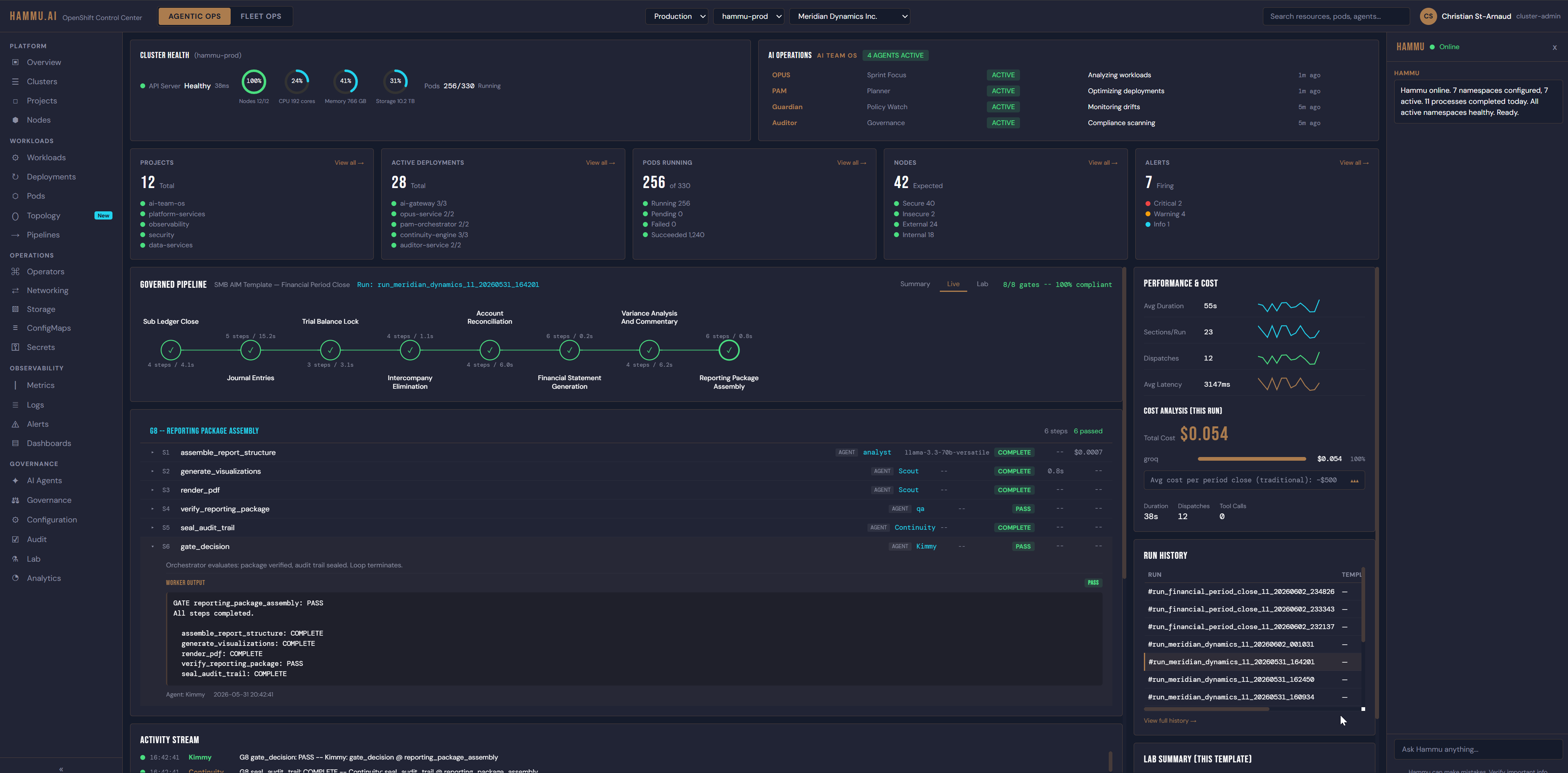
Hammu executes complete business processes through bounded AI-agent teams — inside templates of loops, gates, and verification rules. Every step is bounded, verified, persisted, and recoverable — so a complete, auditable record exists by default.
Not a mockup. This is a screenshot of Hammu running in production — a governed process executing through gates, with the verified audit trail it produces.
Most AI products wrap a model and hand you whatever it returns. Hammu is the layer that doesn't take the answer on faith — it runs the whole process, checks every step against the rules, and only lets verified work move forward. The language model is a component inside the runtime, not the thing you're buying.
A process runs as a template-defined sequence of steps and gates. Each gate enforces verification before the next step is allowed to proceed — and every result is captured as a persisted artifact. The run produces a recoverable decision chain by construction.
Real processes branch. Hammu governs the whole shape — routing, escalation, parallel review paths, risk tiering — with the same gate-by-gate proof as a straight line. However many ways it forks, nothing advances unproven.
Hammu doesn't suggest controls and hope they're followed. It enforces them. Governance is part of the runtime — not a prompt, not a policy document, not an afterthought. These mechanisms are how that guarantee is delivered.
Every process runs inside a defined template of steps, gates, and rules. Behavior is bounded by design.
Information moving between agent roles is checked for integrity, so a mistake in one step can't silently corrupt the next. What each agent acts on is trusted because it was confirmed — not assumed.
Work passes between roles as concrete, reviewable outputs rather than loose conversation — so every exchange is accountable and nothing depends on an agent ‘remembering’ what another meant.
What the system knows and carries forward is controlled and attributable — so shared knowledge stays reliable across a long process instead of drifting.
For decisions that carry real consequence, a result isn't trusted because one agent produced it — it's confirmed before it's treated as final. Confidence comes from proof, not from authority.
Most AI ships with guardrails. Hammu runs on rails.
Most systems assemble an audit trail after the fact, reconstructed from logs. With Hammu, traceability is produced as the process runs — so a complete, source-to-output record exists by default, not as a later integration project.
Every governed run produces the same proof — a technical trace and an audit package. Then it produces the result the process exists for: sometimes a report, just as often an action written into another system.
Full structured execution trace — timing, model attribution, evidence linkage, and execution metadata.
For: engineering, internal audit, debugging, technical diligence.Gates, artifacts, verdicts, calculations, reviewer rationales, evidence references, exceptions, and final confirmation.
For: compliance, risk, internal control, regulated reviewers.The actual result of the work. Sometimes a report — final decision, executive summary, key risks, conditions, recommendations. Just as often an action: a purchase order created in your system, a tenant provisioned, infrastructure scaled, a decision pushed to a downstream system.
For: executives and stakeholders — or the downstream systems that act on it.Hammu operates at two levels using the same governance engine. Delivered as a Kubernetes operator, it runs on OpenShift and Kubernetes — governing the platform itself and the business processes that run on top of it.
A platform operations template governs the operational surface — provisioning, tenant onboarding, health response, incident management, backup orchestration, scaling decisions — through the same loops, gates, and verification that tenant workloads use.
Tenant-specific templates serve domain workloads — mortgage adjudication, employee onboarding, financial close review, vendor qualification. Each tenant gets a template that configures the platform's operational identity for that domain.
Every organization runs processes that recur — closes, applications, compliance, onboarding, claims, etc. They stay manual because no AI could produce a governed, verifiable record. Now one can.
Hammu runs recurring processes end to end, governed, with the audit trail produced as the work runs — not reconstructed after. The verifiable record that kept these processes manual is now a byproduct of doing them.
A single enterprise modernizing operations. A government department processing applications by the thousands. A franchisor running shared services across a network of members. An MSP delivering governed processes to its own customers. The math is the same: process volume times labor saving. The bigger the volume, the wider the gap between what you spend and what the license costs.
Pricing scales with the volume you run, not the people who log in. The justification is in your own actuals — take what you spend in labor today, compare it to the license. The platform pays for itself the moment the multiple clears.
One example — financial close at network scale:
A network of 1,000 members, each running 12 monthly closes.
12,000 closes × 6 hours × $50/hr = $3.6M in labor — conservatively. And that's just the close.
A Hammu license for a network this size returns 5× to 18×.
The same governed runtime, two ways to reach it — run your own instance, or trigger a run on ours and receive the finished, audit-traceable result.
For organizations running processes at volume — enterprise, government, MSP, or network. License the platform and operate it on your own infrastructure. Governed processes at marginal cost, under your control.
Not just the output — the whole engine. Both layers, yours to operate: the governed platform and every process that runs on it, for your own operation and the customers you serve.
A native Kubernetes operator that governs the cluster itself — health checks, tenant provisioning, and deploys run as the same bounded, audited loops. The cockpit work a human operator runs becomes governed too, not just the AI payloads on top.
For organizations that want the result, not a platform to run. Trigger a run; it executes on our infrastructure; you receive a finished, audit-traceable result. Your data lives in a physically partitioned instance — secured, with every access traced to the credential. Fixed cost per run.
A defined process, ready to run. A short, fixed onboarding connects your sources. Fixed cost per run.
Your own process, built from scratch. We learn your business, architect the workflow, and deliver it fully functional, verified, and end-to-end. The engagement scales to the work; the per-run economics don't change.
Any business process executed by AI — financial close, onboarding, vendor qualification — has to be done correctly. There's no ‘close enough’ when the output drives real business decisions. The only way to ensure correctness in agentic AI is governance that's architecturally enforced, not suggested. That this also satisfies the audit and traceability demands of regulated industries is a consequence of doing it right, not the reason it exists.
Request a demo and watch a complete business process execute through gates and verification — and the audit package it produces by construction.